

Kyoto in June is hydrangea (紫阳花) season. Temple gardens turn into quilts of blue, violet, pink and white flowers as rainy season begins, and many of Kyoto’s popular hydrangea sights attract crowds all on their own.
If you’re looking for somewhere a little quieter to enjoy the flowers though, I’ve recently discovered Chishaku- in Temple (智积院) in Kyoto’s Higashiyama district.
Close to some of Kyoto’s busiest attractions, you’d hardly know Chishaku-in was there. It’s situated right next to Sanjusangendo and the Kyoto National Museum, but as soon as we entered the temple grounds and walked past the main buildings, it felt like we left the noise and crowds behind.
Even better, the hydrangea gardens at Chishaku-in are located in the temple grounds’ free area. Keihan’s 2026花便り states that there are around 500 hydrangea planted behind its Kondo Hall, and entrance to the temple grounds is free.
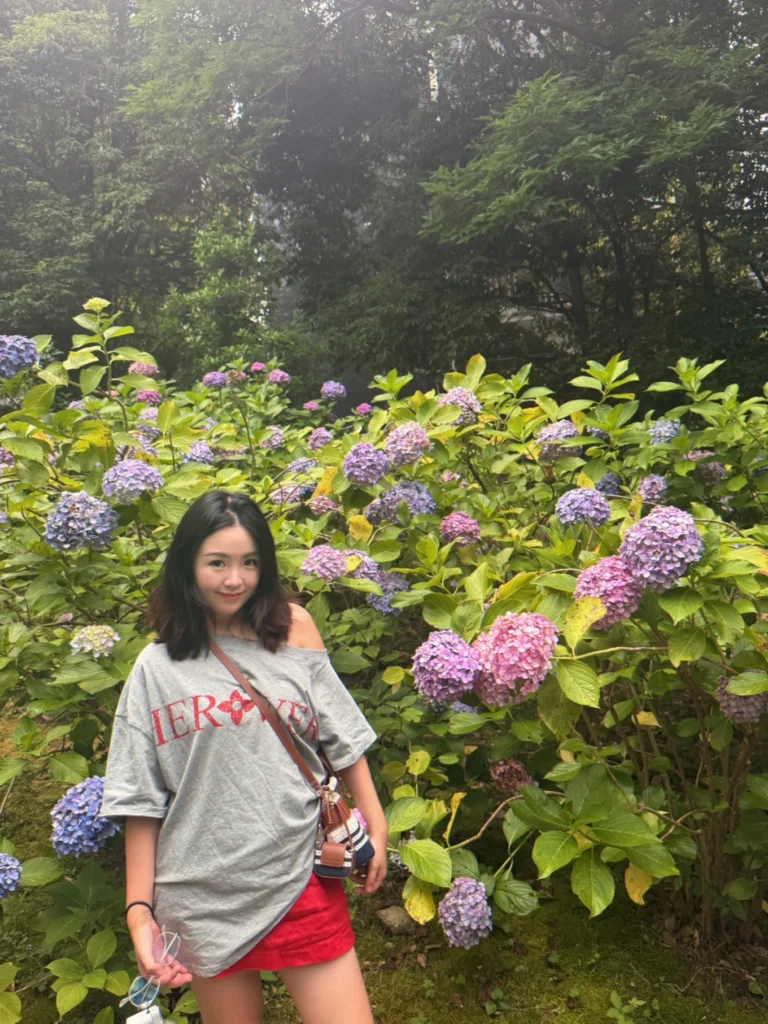
We went later in the season, so I wasn’t expecting to see everything in full bloom. Some leaves were spotted from insect damage and the greenery wasn’t quite as lush as it may have been a couple weeks prior, but there were still hydrangeas blooming everywhere throughout the garden.
It may sound odd, but thinking that we somehow beat the crowds made me love Chishaku-in even more.
You don’t have to weave around people looking for the same shot. It just feels like you stumbled into a temple garden full of hydrangeas.
- Why Chishaku-in Is One of Kyoto’s Best Hidden Hydrangea Spots
- A Temple That Feels Surprisingly Peaceful for Central Kyoto
- Finding the Chishaku-in Hydrangea Garden
- Hydrangeas, Temple Architecture and That Distinctive Kyoto Atmosphere
- We Visited Near the End of Hydrangea Season
- When Is the Best Time to See Hydrangeas at Chishaku-in?
- Don’t Rush Straight Through the Garden
- Chishaku-in Is Much More Than an Ajisai Temple
- Is Chishaku-in Really Free?
- How Long Should You Spend at Chishaku-in?
- Photography Tips for Chishaku-in’s Hydrangeas
- Is Chishaku-in Worth Visiting for Hydrangeas?
- Getting to Chishaku-in
- Final Thoughts: One of My Favourite Kyoto Hydrangea Discoveries
Before going on this trip I probably would not have considered Kyoto as a place to see hydrangeas. Locations like Mimuroto-ji in Uji would spring to mind.
But Chishaku-in isn’t one of those places.
That’s exactly why I loved it.
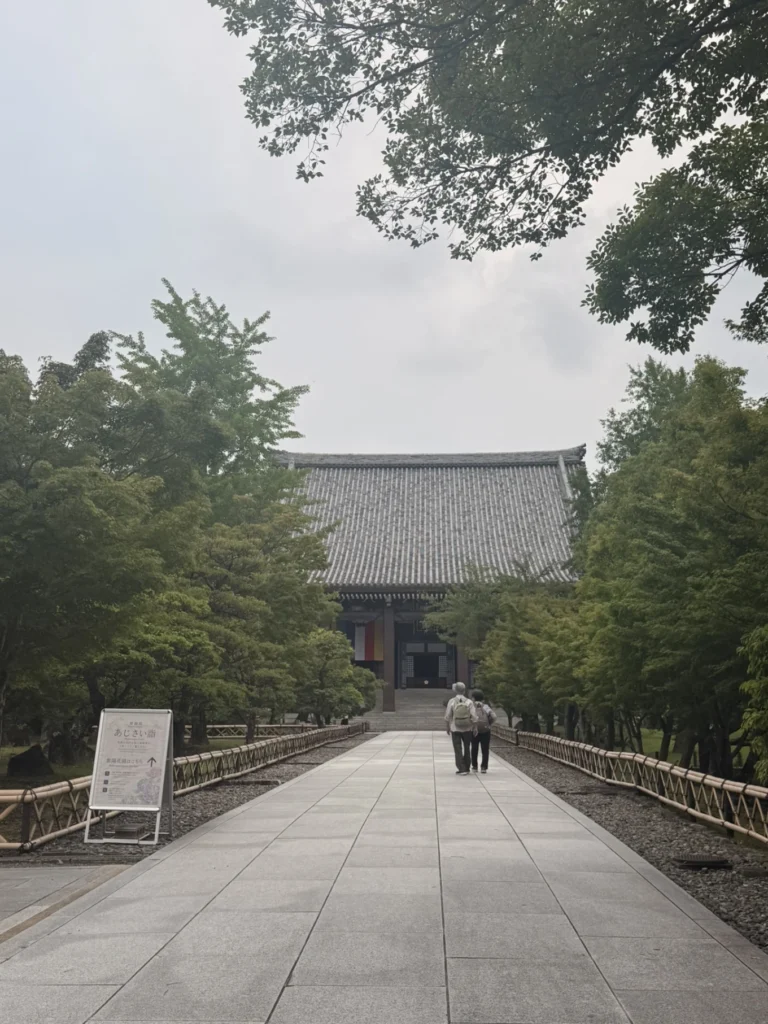
There’s no flashy entrance into some giant commercially-popular flower festival. You walk up a long stone path lined with large trees and old school temple buildings and bamboo fencing.
At the end of the long pathway sat one of Chishaku-in’s large temple buildings, framed by trees on either side. There were a couple other guests slowly wandering ahead of us, but aside from that the garden felt serene.
Stepping onto the grounds was one of those quintessential Kyoto moments where you just slow down.
You could easily stumble upon Chishaku-in just because you’re sightseeing in Higashiyama. But come hydrangea season, it’s a spot I’ll intentionally make time to visit when in Kyoto.
A Temple That Feels Surprisingly Peaceful for Central Kyoto
One of the reasons why I feel so comfortable recommending Chishaku-in is location.
You won’t have to go too far out of Kyoto to find it.
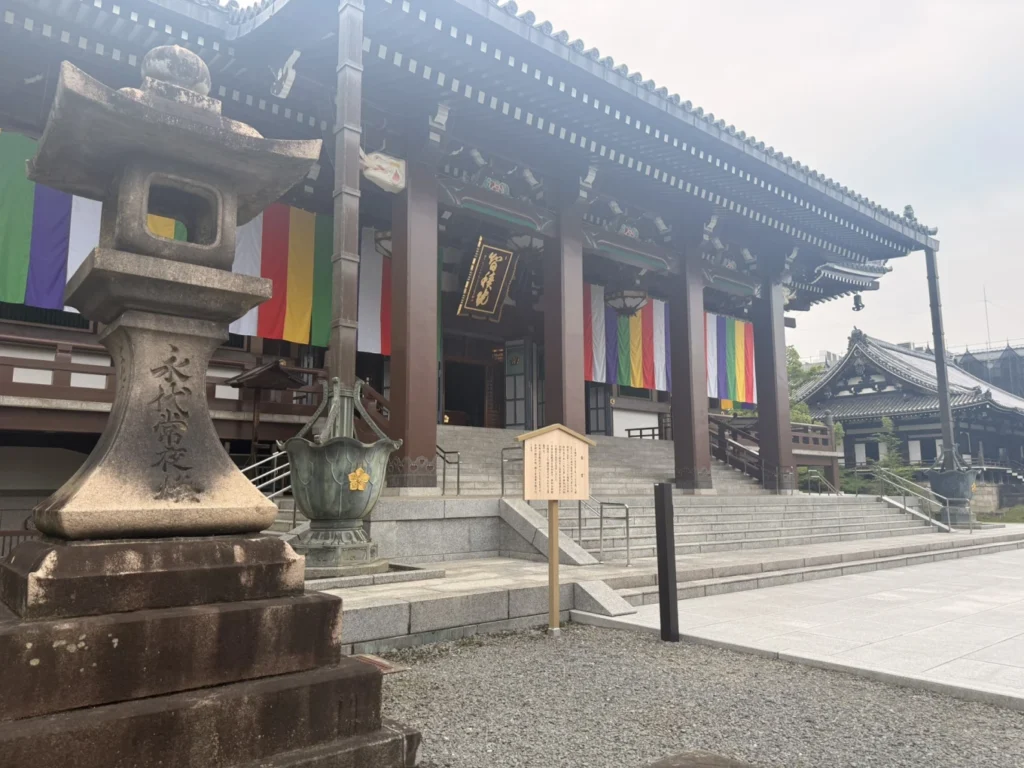
Situated in Kyoto’s Higashiyama neighborhood (東山), Chishaku-in is accessible from Keihan’s Shichijo Station (壬生寺駅) in about 10 minutes. The temple can be found at 964 Higashikawaracho, Higashiyama-ku Kyoto.
Despite being located in a fairly centralized area of Kyoto, it felt a lot more tranquil inside.
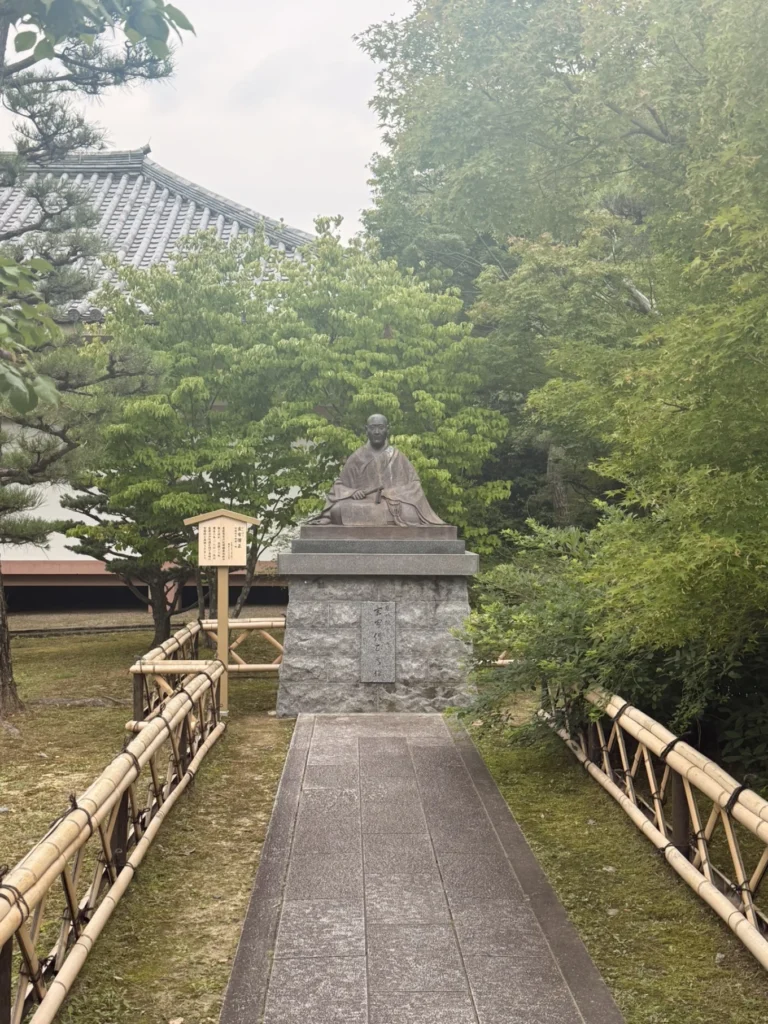
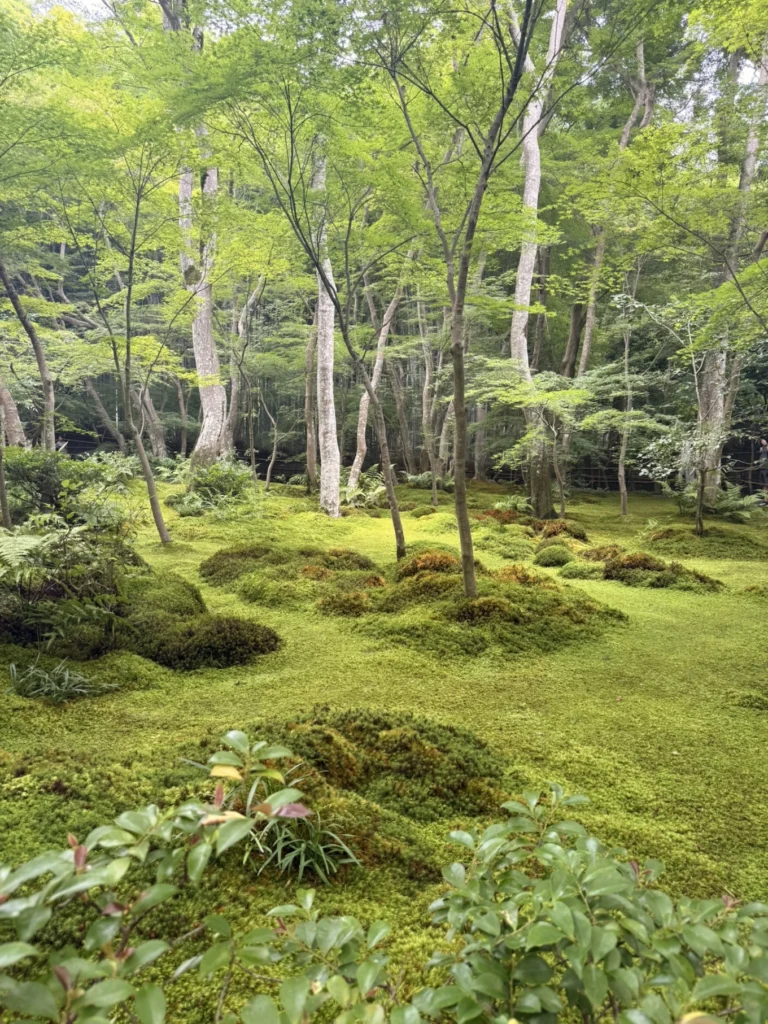
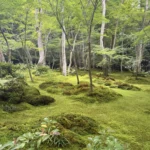
Walkways are broad. Magnificent trees cover parts of the garden. Moss, rock, bamboo fences and traditional structures take the place of city life as you step closer to Chishaku-in.
Before we got to the hydrangeas, I knew Chishaku-in was worth the trip.
That may sound silly, but it’s an important point to make.
You can go to a destination that solely features flowers and feel let down if you miss peak bloom by even a day. At Chishaku-in, the gardens are just one aspect of your visit. Even if you happen to go a few days early or late, you’re still at a historic temple in Kyoto.
Finding the Chishaku-in Hydrangea Garden
The hydrangea garden is situated behind the Kondo Hall. Keihan estimates that 500 hydrangea plants grow here in their 2026 seasonal guide.
Our visit took on a whole new feel when we reached this area of the garden.
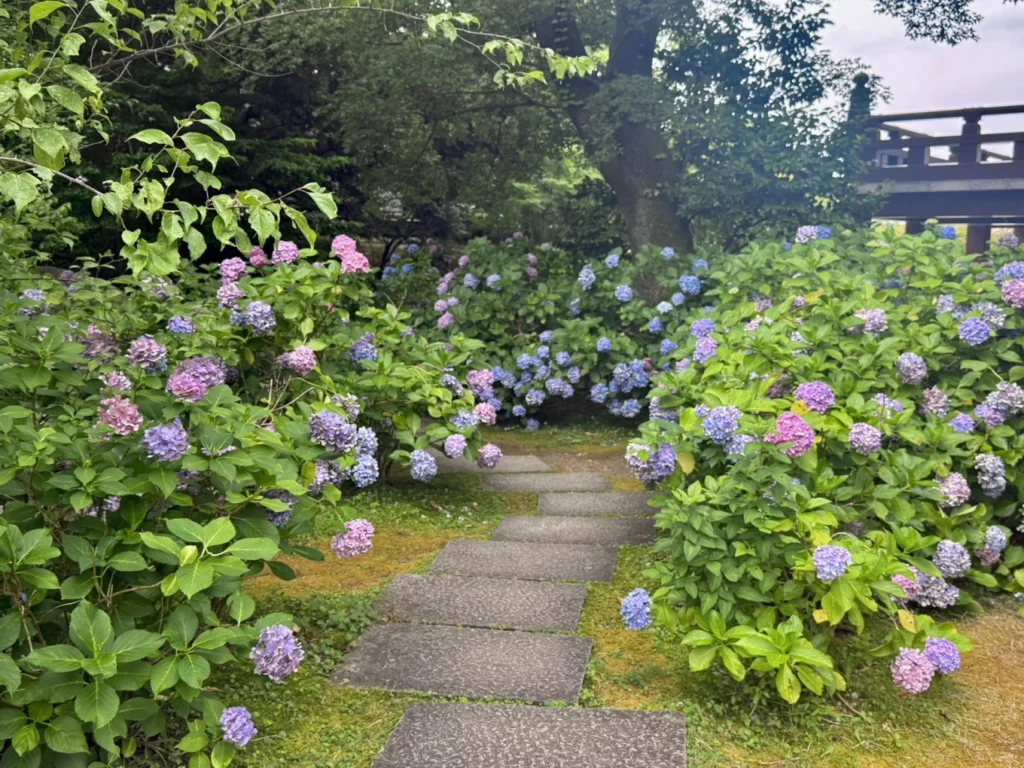
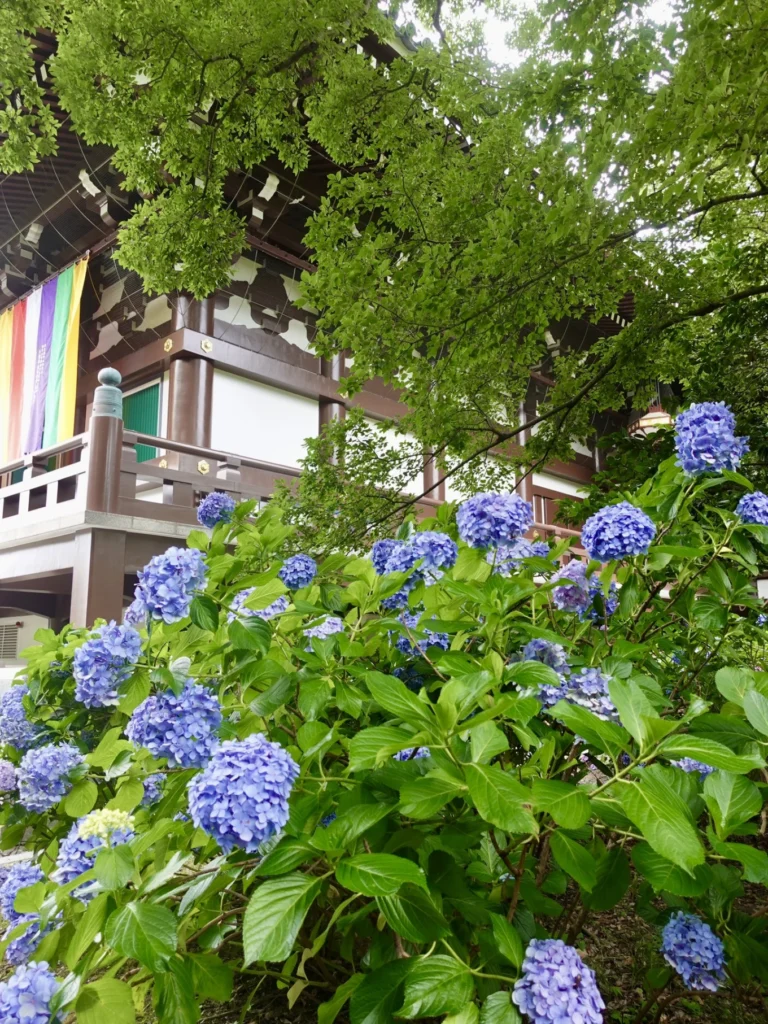
Blue and purple flowers peeked through between trees.
And then there were more.
And MORE.
Eventually whole sections were devoted to hydrangeas, showcasing varying stages of bloom.
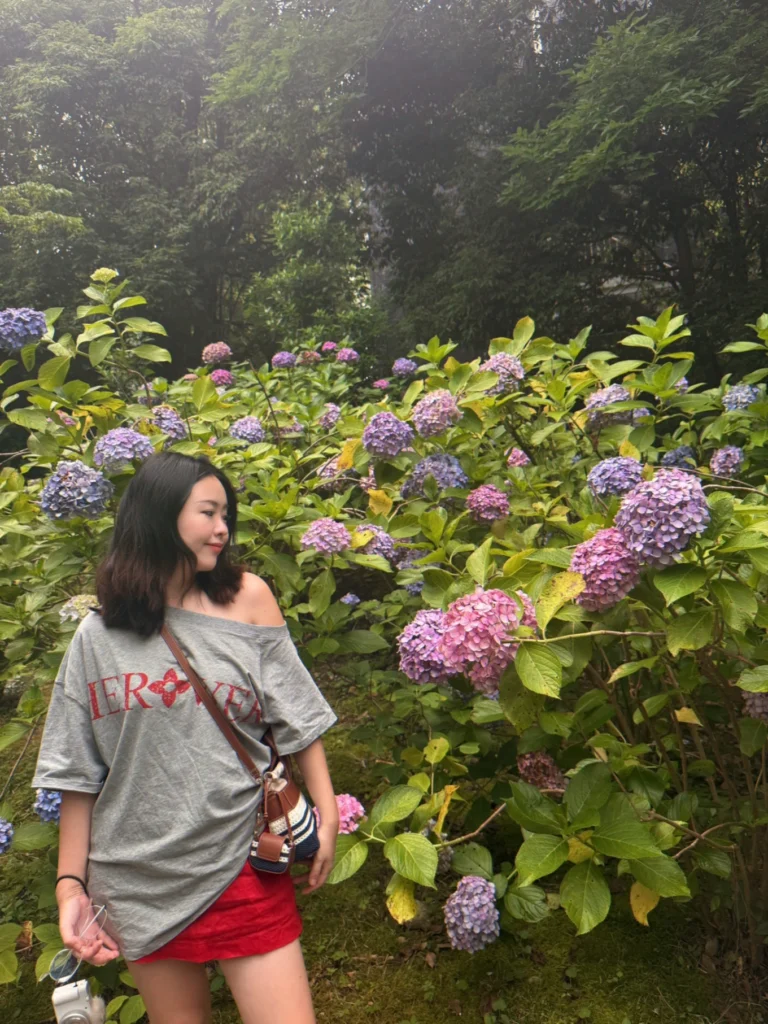
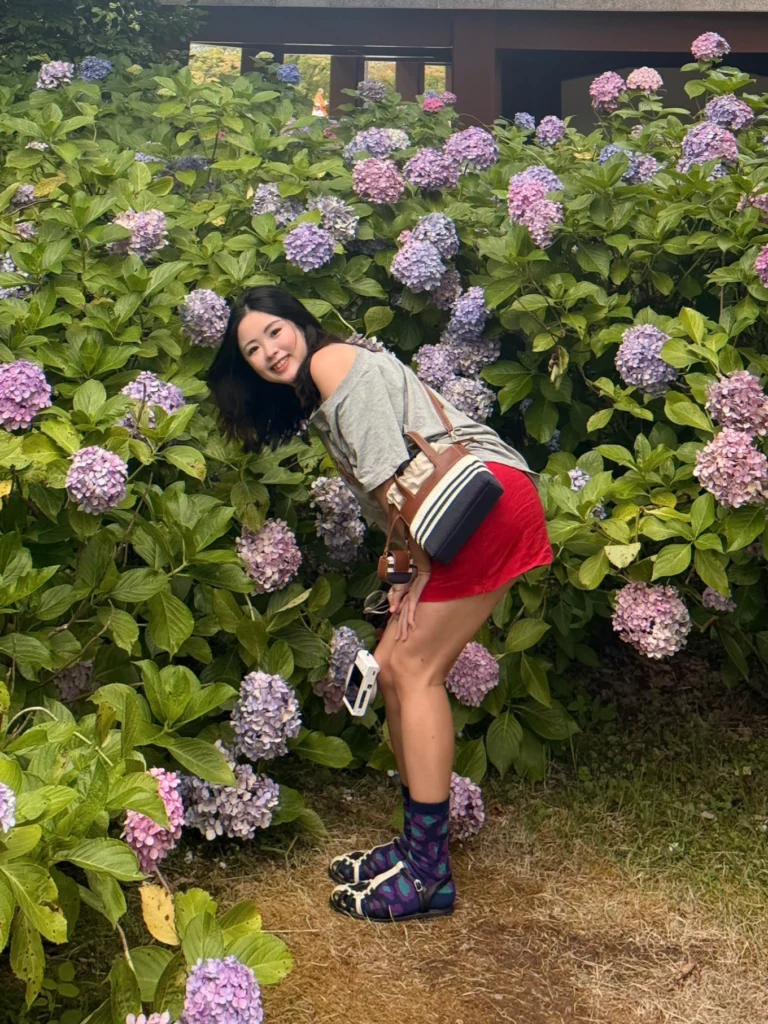
Some were light powder blue. Others verged on violet. Pink blossoms mixed in with them too, and older blooms had taken on those dull purples and faded-out colours that mark the transition to late-season.
I loved seeing the contrasts, actually.
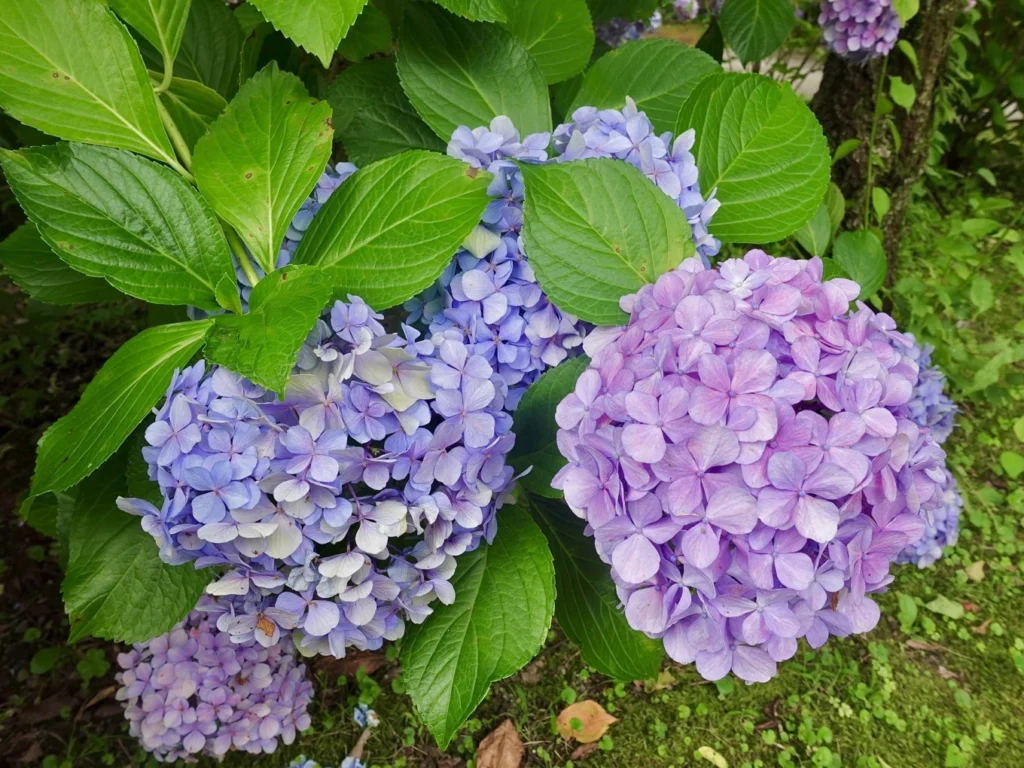
Up close, a hydrangea is not just one massive flower. They’re made up of dozens of smaller petals, and the variation in colour becomes quite clear when you slow down to really look.
My favourite picture from our visit was really just a close-up shot of two hydrangea “heads” – one pale purple-blue, the other pink – nestled amongst huge green leaves.
Hydrangeas, Temple Architecture and That Distinctive Kyoto Atmosphere
I think the thing that makes Chishaku-in’s hydrangeas different than the flowers at your typical botanical garden is the backdrop.
We could see parts of the temple buildings behind the flowers at various points.
Dark wooden pillars and white walls peeked through the flora. Bright Buddhist banners hung from the building, while massive bouquets of blue hydrangeas dominated the foreground.
That was exactly what I was hoping to encounter.
While there are tons of great places to take photos of flowers in Japan, the photos I remember most fondly are ones where you know exactly where they were taken. See, a macro shot of a hydrangea petal could’ve been taken just about anywhere.
But a hydrangea layered with an ancient temple in Kyoto tells you a story.
There were also stone pathways that weaved through and around the plants rather than just blocking off one giant flower field. That helped add to the intimacy of the garden. In some spots, the hydrangeas almost overwhelmed the pathway.
We stopped to take photos about a million times.
And you could take your time too, which can’t always be said about popular seasonal destinations. Usually at those type of places, there is someone impatiently waiting behind you.
We Visited Near the End of Hydrangea Season
We visited pretty late in the season.
This deserves mention because travel guides and articles will often display attractions when they’re at their absolute best without specifying WHEN those photos were taken.
When we visited some of the hydrangea leaves had notable insect bites. Some blooms were drying up and certain patches were clearly past their prime.
Had I gone JUST to see perfect hydrangeas I probably would have liked to have gone earlier.
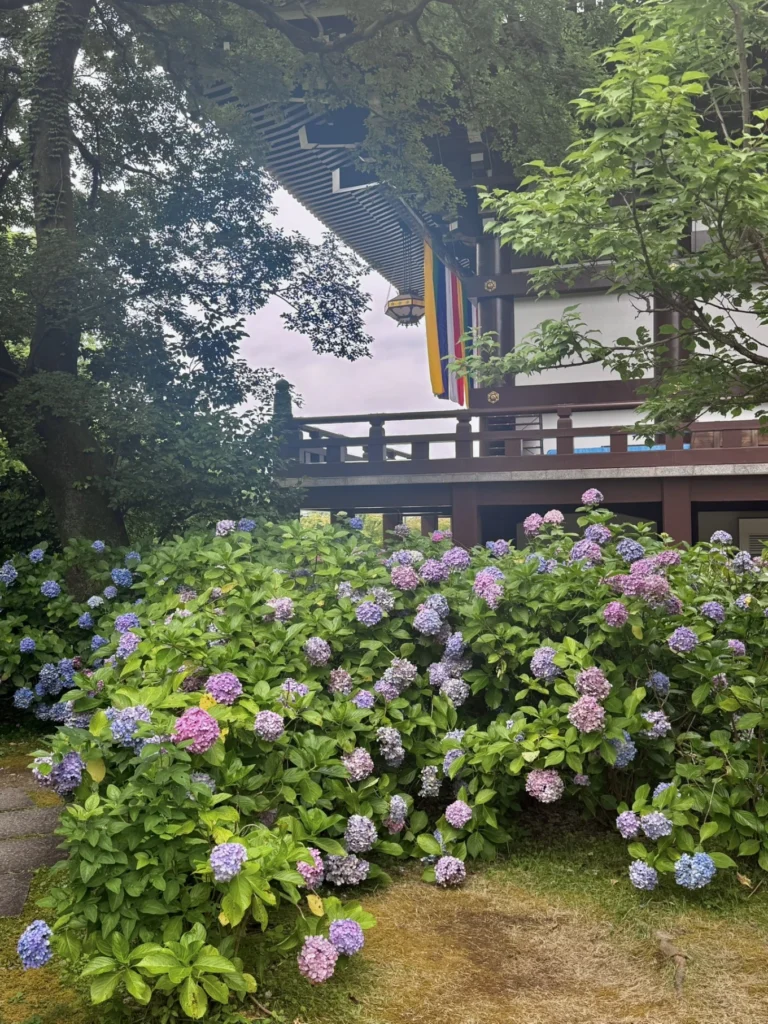
That being said there were still tons in bloom! Including big patches of pink, purple and blue hydrangeas throughout the garden.
Past perfection also lent the garden a different vibe. Instead of vibrant electric colors you’ll find at the peak of the season some of the flowers had faded to dusty pinks and muted purples.
Which wasn’t necessarily a bad thing for photography.
Regardless we still left with WAY more photos than we expected.
More than anything our experience visiting Chishaku-in taught us that the temple is worth visiting even if your trip to Kyoto doesn’t align perfectly with peak bloom.
When Is the Best Time to See Hydrangeas at Chishaku-in?
I’d plan on early to mid-June if possible, but be flexible based on that year’s conditions.
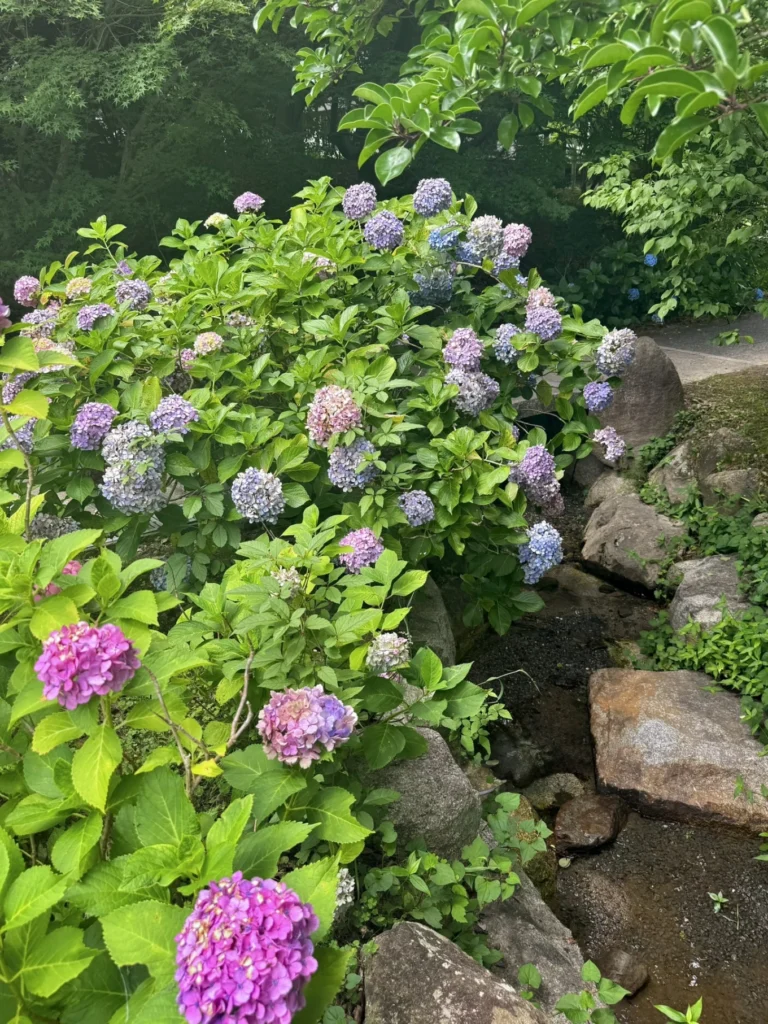
According to a 2026 map guide to Kyoto hydrangeas, Chishaku-in typically blooms from around early to late June. I saw the garden in near peak condition on June 4, 2026.
Keep in mind that hydrangeas depend greatly on the weather, so try not to stress about one set date.
That being said, if viewing flowers are a primary motivation for your trip, I’d check Chishaku-in’s social media channels closer to your visit. The temple’s website is under construction at the moment and it specifically advises visitors to monitor its Facebook, Instagram, and YouTube pages for updates.
If photography is your main goal, I’d rather visit a few days before peak than a couple weeks after.
Don’t Rush Straight Through the Garden
I could’ve easily gotten here, snapped a few shots of the hydrangeas, and left.
I wouldn’t do that, though.
A lot of Chishaku-in’s magic is just aimlessly walking around.
Past the bigger groupings of flowers there were quieter areas of the garden. Parts that were filled with rocks, moss and thick foliage. We even stumbled upon a small pond with lotus leaves floating on much of the surface and a single pale pink lotus flower sitting on top of them.
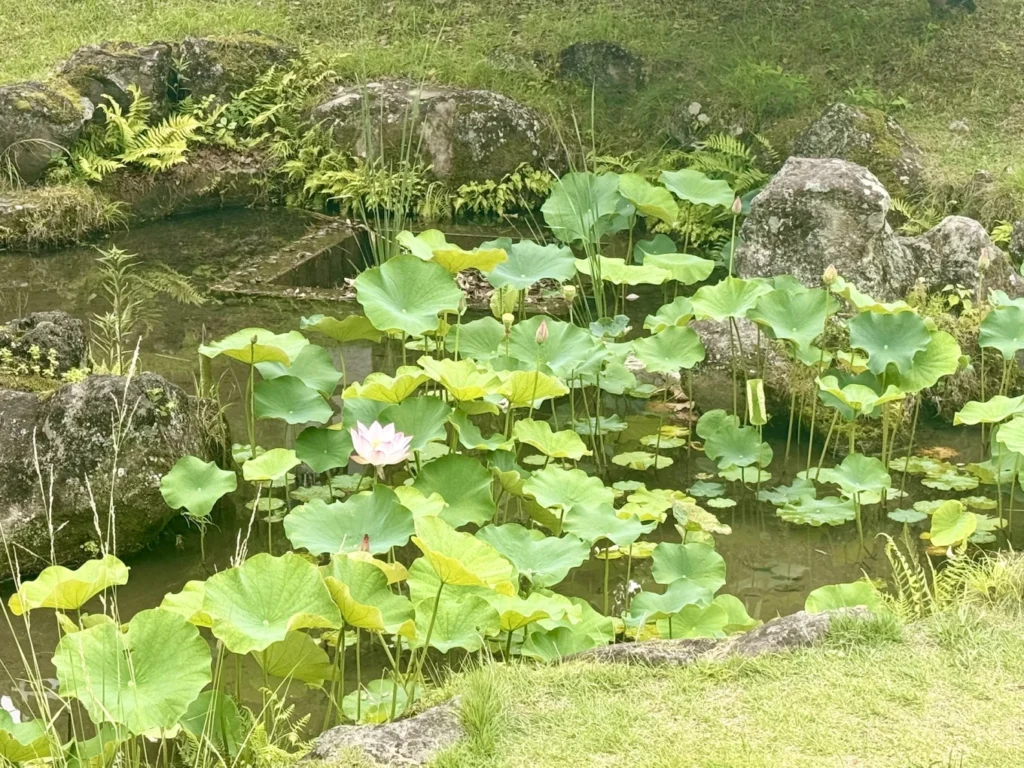
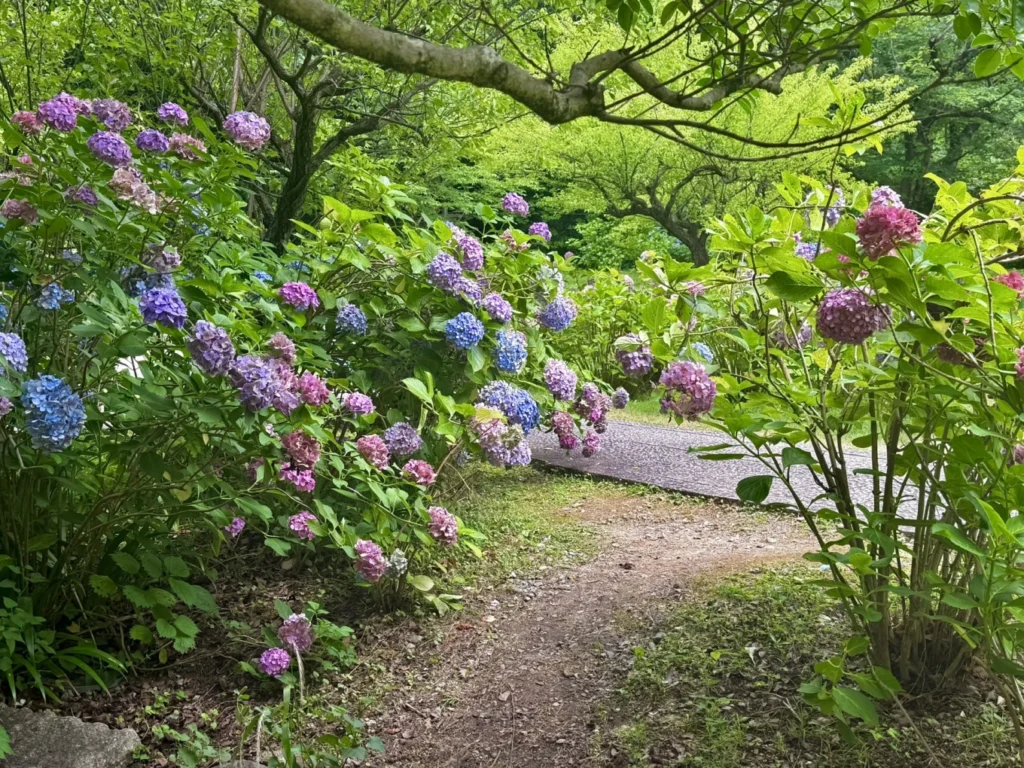
These areas weren’t exactly highlighted on the temple’s “things to see” list.
They were special because we stumbled upon them.
I love that about Kyoto. You know the popular spots are popular for a reason but I’ve found some of my favourite memories are made during the in-between times — when I’m not trying to find that one photo I should take.
You get lots of those opportunities at Chishaku-in.
Chishaku-in Is Much More Than an Ajisai Temple
It may seem like this article is just about Chishaku-in and its hydrangeas, but there’s much more history at this temple than that.
Chishaku-in is the main temple of the Chisan School of Shingon Buddhism, with 3,078 temples across Japan under its jurisdiction. It originally had ties with Negoro in former Kii Province. When the previous temple buildings were burned down by Toyotomi Hideyoshi, the supporting priest Genyu was later backed by Tokugawa Ieyasu and re-built Chishaku-in in Kyoto in the early 1600s.
The temple grounds also include land that was affiliated with Shounzen-ji, which Hideyoshi built to pray for the soul of his young son Tsurumatsu. Here you can find several important artistic properties related to that story, including National Treasure sliding-door paintings by Hasegawa Tohaku and others in his school.
You’ll also find one of Japan’s Registered Places of Scenic Beauty here: a pond garden that dates back to the Momoyama period. (Admission applies here, unlike the free hydrangea area.) If you have the time, you can make a strong case for exploring more than just the blooms.
Is Chishaku-in Really Free?
Yes — the general temple grounds and hydrangea garden are free to enter.
This is probably the single biggest reason why I suggest Chishaku-in to visitors coming to Kyoto in June.
From what I can find on Keihan’s 2026 info page, entering the temple grounds themselves is free. Entry to the separate famous garden is currently ¥500 for adults, ¥300 for junior-high and high-school kids, and ¥200 for elementary- school kids.
Price and arrangements are subject to change, so double-check before your visit if you plan to enter any of the paid areas.
If you’re just coming to see the hydrangeas, however, you can still have an unexpectedly lovely Kyoto blossom experience without paying admission.
How Long Should You Spend at Chishaku-in?
If you are coming primarily to see the hydrangeas, I’d probably budget closer to 45 minutes to an hour.
This will allow you plenty of time to stroll around the property at a leisurely pace, visit the hydrangea garden, take pictures and soak up the atmosphere of the temple. Photographers may well want to stay longer.
If you’re visiting both the ticketed garden and cultural buildings as well, you will want to budget significantly more time. Chishaku-in works very well as part of a day spent exploring eastern Kyoto too, since Sanjusangendo and the Kyoto National Museum are nearby. Rather than considering it a full half-day trip, I view Chishaku-in as one of the very best ways to enhance a day of sightseeing in the Higashiyama district.
Photography Tips for Chishaku-in’s Hydrangeas
Sure, the garden is extremely photogenic. But for me, the best compositions centered around flowers were not always close-ups of flowers.
You might try pulling back and capturing the temple as well.
Blue hydrangeas with dark green leaves contrast beautifully with Chishaku-in’s dark wood temple buildings, lending your images a feel you just can’t capture with flowers alone.
Utilizing the garden’s narrow paths also helps provide depth to your photographs. Any shot that features a path disappearing into hydrangeas immediately grounds your photo in the garden.
And don’t dismiss cloudy weather.
June weather in Kyoto can be very grey, but diffused, moody light complements hydrangeas perfectly. Strong shadows are eliminated and the colors become far easier to capture.
If you get rain, consider it a bonus.
After all, this is Japan’s rainy season flower.
Is Chishaku-in Worth Visiting for Hydrangeas?
Yes, definitely — especially if you like uncrowded temples and leisurely sightseeing instead of hitting only the most famous spots in Kyoto.
I wouldn’t visit Chishaku-in if I were trying to find the temple with the biggest number of hydrangeas.
But that’s not the point.
Hydrangeas aside, what’s cool about Chishaku-in is that you get a whole bunch of other stuff too.
Beautiful traditional Kyoto temple architecture, old established gardens, a legitimately tranquil ambiance, and all within easy-access of the city.
Visiting didn’t feel like the flowers were stealing the temple’s identity.
Rather, the flowers fit right in.
Getting to Chishaku-in
Temple: Chishaku-in Temple (智积院)
Japanese: 総本山智積院
Area: Higashiyama, Kyoto
Address: 964 Higashikawaracho, Higashiyama-ku, Kyoto
Nearest train station: Keihan Shichijo Station, approximately 10 minutes on foot
Hydrangea location: Behind the Kondo Hall
Number of hydrangeas: Approximately 500 plants
Typical hydrangea season: Early to late June
Temple grounds: Free
Scenic garden: Separate paid admission
Listed reception hours: 9:00 AM–4:00 PM
Best for: Hydrangeas, quiet Kyoto temples, photography, couples and slower-paced sightseeing.
Final Thoughts: One of My Favourite Kyoto Hydrangea Discoveries
Chishaku-in is why I still enjoy getting lost in Kyoto despite having ticked off so many of the city’s famous temples.
Sometimes Kyoto’s best spots are the ones without the crowds or the marque names.
We arrived late in hydrangea season and certainly didn’t see the garden at its best. Leaves were damaged from storms, some flowers were wilting and all the colours lacked their peak-season punch.
Still, there were hydrangeas everywhere you looked.
Pink and violet blossoms draped over narrow walkways. Massive blue blossoms sat below the temple’s balconies. Behind them waited ancient trees, moss, stone lanterns and the dark wooden architecture of Chishaku-in.
And for most of our visit it was quiet. Really quiet.
Visit Chishaku-in during Kyoto’s hydrangea season if you’re looking for somewhere beautiful that still lets you experience the city’s quieter, more contemplative side. Come for the ajisai, leave with time to wander.




Leave a Comment